Whoever Holds the Key Holds the Bill: A Control-First Corridor for Digital Trade Documents on Aergo
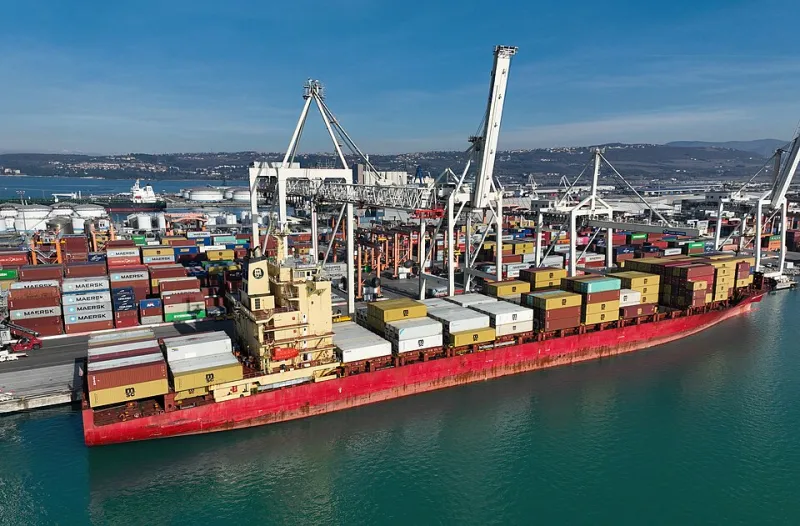
Photo: Petar Milošević, CC BY-SA 4.0, via Wikimedia Commons
A statute is not a system
When the Electronic Trade Documents Act came into force on 20 September 2023, it did something the UK trade community had wanted for years: it stopped treating a bill of lading as necessarily a piece of paper. Parliament did not, however, ship an exporter a working platform. It created a legal test, and left the market to build systems that satisfy it.
That gap is where most digital trade projects quietly stall. Legal teams read the Act and conclude that digital documents are now permissible. Engineering teams read the same text and discover that "permissible" translates into three demanding technical properties — and that the shipper, the bank, the freight forwarder and the customs broker all have to accept the same answer.
This article is about building that answer on an enterprise chain. Not a marketplace, not a document management system with a hash bolted on, but a corridor: a controlled path along which a trade document moves, with custody recorded at every step.
Reading three statutory tests as engineering requirements
The Act's substance is familiar to anyone who has followed the Model Law on Electronic Transferable Records. A document in electronic form can stand in for its paper equivalent where there is a reliable means of identifying it, a reliable means of establishing exclusive control, and a reliable means of transferring or divesting control. The reliability of the system holding the document is itself part of the assessment.
Translated for builders, those become three design obligations:
Identification. The record must be singular and unambiguous. Two copies that both claim to be the original bill are not a document; they are a dispute waiting to be funded. This means a unique, non-duplicable identifier whose state is authoritative and universally readable.
Exclusive control. Control must be demonstrable, not merely asserted. If a forwarder can quietly re-issue a receipt, or an intermediary retains an unlogged administrative route into the record, exclusive control is a claim rather than a property.
Transfer. Divestment must be atomic and evidentially complete. When control passes from seller to bank, the seller's ability to exercise control must end in the same event that confers it on the bank.
Note what is absent from that list: immutability as an aesthetic goal, token prices, public transparency for its own sake. The Act is uninterested in any of them.
What a general-purpose chain gets wrong
A public chain gives you a durable, tamper-evident log, which is genuinely useful. It also gives you a design problem: the parties in a trade corridor are not anonymous, and the information they exchange is commercially sensitive. Publishing a hash of a bill of lading to a global ledger satisfies almost nobody — the exporter dislikes the metadata leakage, the bank dislikes the inference risk, and the customs broker cannot use a hash to clear goods.
The recurring failure mode is treating the chain as a filing cabinet. It is not. A corridor needs a small, precise ledger of state transitions — who controlled which document, when, and under what authority — alongside a private store for the documents themselves, with the two bound together by digest.
This is where a hybrid enterprise network such as Aergo becomes a reasonable fit rather than a fashionable one. Contracts can be written in Lua or through Aergo's SQL contract support, the network can be operated as a permissioned consortium with known validators, and the public chain can be used as an anchoring floor for periodic digests. Freight forwarders get a private network with predictable throughput; auditors get a public, timestamped anchor they can verify without access to commercial paperwork.
The corridor, step by step
Consider a containerised export from Felixstowe to Singapore, financed by a letter of credit.
- Issuance. The carrier's system mints a document record with a deterministic identifier derived from booking reference, container number and issue timestamp. The digest of the underlying PDF is committed alongside.
- Custody assignment. Control is assigned to the shipper. The assignment is a transfer event, not a database flag.
- Endorsement chain. Each subsequent movement — shipper to negotiating bank, bank to presenting bank, bank to consignee — appends to the same chain. Earlier entries are not overwritten; they are superseded by an event that names the prior holder.
- Presentation. The bank reads state directly from the corridor rather than from an email attachment. The digest check confirms the document it holds is the document the ledger describes.
- Delivery. On payment, control moves to the consignee. The carrier's release instruction is generated from ledger state, not from a phone call.
- Anchoring. At a defined interval, a Merkle root of the event log is written to the public Aergo chain, giving every participant an independently verifiable chronology.
- Retention. Records are held in line with the exporter's document retention policy and, where relevant, HMRC record-keeping expectations.
Each step is deliberately boring. Boring is the point: the value of the corridor is that a dispute at step five can be resolved by reading steps one to four.
Four parties, four different questions
The exporter wants to know that it has not lost control of goods it has not been paid for. The bank wants assurance that the document it is financing cannot be duplicated and presented twice. The forwarder wants an interface that does not require staff to learn a new religion. The customs broker wants a declaration it can stand behind, in a format the CDS filing tolerates.
A corridor that answers only the first two is a pilot. A corridor that answers all four is infrastructure. In practice this means exposing read-only views per role: the broker sees document identity and status but not pricing; the bank sees the endorsement chain but not the underlying commercial invoice; the forwarder sees the operational events that concern it. Selective disclosure is not a compromise on the Act's tests — it is how you keep four mutually suspicious parties on the same ledger.
The pre-build artefact checklist
Before a single contract is deployed, a counterparty's counsel will ask for the following. Producing them early is cheaper than producing them under pressure.
- A written description of the identification scheme, including how duplicate issuance is prevented at source.
- A control model diagram showing every actor with administrative access, and the evidence trail for each privileged action.
- The transfer specification: what constitutes a valid transfer event, who signs it, and what happens if two transfers are submitted concurrently.
- A key management statement covering custody of signing keys, rotation, and recovery, including the human process behind it.
- A reconciliation procedure for the private store and the on-chain digest, with a defined response to mismatch.
- A service description for the anchoring layer, stating interval, verification method and what participants do if anchoring lags.
- An exit plan: how documents and their evidence are extracted, in what format, and with what verification, if the consortium dissolves.
- A data protection assessment covering personal data that travels with a shipment — names, signatures, contact details — and the lawful basis for processing it across borders.
The last two are routinely omitted and routinely decisive. Corridors fail at handover far more often than at launch.
Where the discipline has to live
The Electronic Trade Documents Act removed a legal obstacle. It did not remove the harder obstacle, which is that four organisations with different incentives must agree on a single version of events. A chain does not create that agreement; it merely makes disagreement visible.
That is still worth building. A corridor in which control is provable, transfers are atomic and the audit trail is readable by parties who do not trust each other is a genuine improvement on a PDF in an inbox and a promise in a phone call. The Act gave UK trade the vocabulary. The work now is in the wiring.